
Overview
In December 2023, the Independent Review into the National Disability Insurance Scheme (NDIS) (the Review) was published. As well as recommendations about improving the NDIS, the Review recommended that governments invest in supports for children and their families outside of the NDIS, calling for:
- mainstream supports that are more inclusive and accessible
- more supports outside the NDIS for people with disability and developmental delay (known as ‘Foundational Supports’)
- a new NDIS early intervention pathway for children.
In December 2023, governments agreed to work together to design and deliver Foundational Supports. The first area they focused on was the design of supports focused on children aged 0–8 years with developmental delay and/or autism with low to moderate support needs.
In August 2025, the Australian Government said it would provide $2 billion over 5 years for these supports for children, called ‘Thriving Kids’. State and territory governments are expected to match this investment.
To support the development of Thriving Kids, the Minister for Health and Ageing and the Minister for Disability and the National Disability Insurance Scheme, the Hon Mark Butler MP, set up the Thriving Kids Advisory Group (the Advisory Group) in September 2025. The Advisory Group was co-chaired by Minister Butler and Professor Frank Oberklaid AM. Members of the Advisory Group included experts from child health and development, research, disability, child and family services, parenting, health care, and early education and schools. The Advisory Group also included First Nations views, members with lived experience, and state and territory government representation.
The Advisory Group provided advice to government on a proposed national model for Thriving Kids (the proposed model). This summary report explains what the Advisory Group recommended. The proposed model was tested with:
- Disability Representative Organisations (DROs)
- people with lived experience, including First Nations people and culturally and linguistically diverse people.
Thriving Kids will aim to pick up developmental delays in children sooner. It will include supports across Australia that help children with developmental delay and/or autistic children with low to moderate support needs aged 0–8 and their families, carers and kin. Children with permanent and significant disability will still receive support through the NDIS.
The final design of Thriving Kids will be agreed between the Australian Government and state and territory governments. Governments will keep talking to people with disability and the community as they set up supports.
For more information on Thriving Kids, refer to the Department of Health, Disability and Aging web page on Thriving Kids.
Summary of the proposed Thriving Kids model
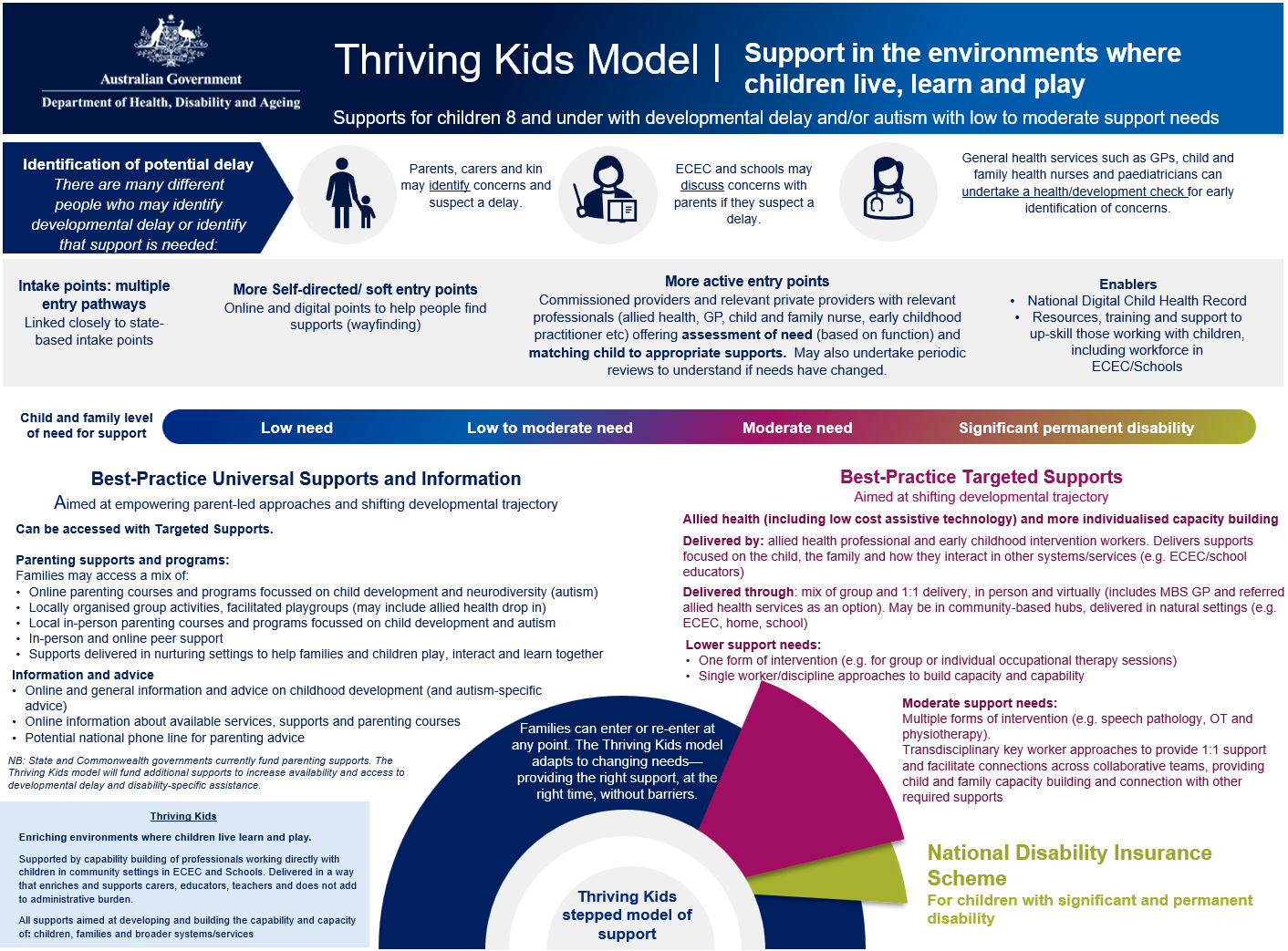
The Advisory Group recommended that governments should consider the proposed model at Figure 1 for the services Thriving Kids should provide. This summary explains each part of the model and how it should work.
The proposed model includes supports that help:
- to identify developmental delays and connect people to supports
- parents and families to build their skills, connect with others and find information (known as ‘Universal Parenting Supports’)
- children and families who need more help than Universal Parenting Supports to access allied health and more intensive capacity building (known as ‘Targeted Supports’)
- ensure Thriving Kids works well and connects with other service systems, such as the NDIS.
The Advisory Group recommended that children be connected with a range of information and supports that address the child’s level of need.
The Advisory Group recommended that governments should use a range of principles to help them design Thriving Kids so services are:
- centred on the needs of children and families and based on their strengths
- informed by evidence
- delivered in the everyday places children and families live, learn and play
- connected and collaborative
- focused on outcomes
- flexible, accessible and culturally safe
- supporting the workforce that delivers them.
They also recommended that services recognise the National Best Practice Framework for Early Childhood Intervention. The framework gives advice on how to support children under 9 years of age who have developmental concerns, delays, or disabilities. It helps families and professionals understand what good support looks like and how to provide it.
Identifying developmental delays and connecting families to supports
Children connect with many people, including health workers, early childhood educators, teachers and community services. These connections provide opportunities for developmental delay and a child’s support needs to be noticed early. The proposed model looks to strengthen these opportunities so children and families who need support can be identified early by the different people and systems they are regularly connected with. This will help children and families to access supports earlier in their child’s life where they can help the most.
The model also seeks to ensure families have easier access to accurate advice and support – both online and in-person. Parents play a key role in their child’s development, but there is not always good information around what a developmental delay may look like, or how to support their child’s growth.
The Advisory Group’s model recommends Thriving Kids should provide information, resources and awareness raising about child development in a way that is inclusive, neuro-affirming and culturally responsive. Information and support should:
- reduce harmful attitudes towards developmental delay and disability
- raise awareness of developmental delay and disability
- celebrate developmental diversity
- respect the strengths and experiences of all cultures and communities
- help families to make decisions, advocate for their children, and access timely supports.
Improving awareness and access to evidence-based, quality information about child development, neurodevelopmental difference, and relevant services will help families to:
- more readily identify and better explain concerns
- access practical strategies and advice
- feel more confident supporting their child’s development
- seek appropriate and timely support when needed.
The Advisory Group also recognised that it can be hard for families to get a formal diagnosis. Members recommended that Thriving Kids should give families early access to supports without them needing a formal diagnosis.
The Advisory Group’s model also focuses on navigation, to help families understand what information, supports and services are available and make it easier for families to access them. Many parents, carers and kin find it hard to navigate the service ecosystem. The Advisory Group wanted there to be multiple ‘entry points’ so that there is no ‘wrong door’ to seeking support.
Best-practice Universal Parenting Supports
The Advisory Group highlighted that families, carers, and kin are the first teachers in a child’s life. To support them in this role, Thriving Kids should deliver Universal Parenting Supports that help families to build:
- knowledge and skills in supporting their child’s development
- strong relationships with their children and other people in their lives
- peer support through connections with others who have had, or are going through, the same experiences.
Early access to these supports can help to develop the strengths and wellbeing of families and may limit the need for extra supports later in life.
Parenting supports under Thriving Kids should be:
- inclusive, flexible, and tailored to the different needs of children and families
- easy to access
- evidence-based
- delivered in environments where children live, play, and learn
- offered in different ways, such as through online courses, short videos, resources families can use in the home, peer support groups, supported playgroups, family programs, supporting self-advocacy, and culturally safe training.
All supports and programs should be evaluated to ensure they are working well for families and are and culturally responsive, particularly for First Nations and culturally diverse families.
Best-practice Targeted Supports
The Advisory Group recommended that Targeted Supports should be delivered for children and families who need more help than Universal Parenting Supports alone. These supports include things like allied health and more individualised capacity building for families and children.
Targeted Supports should help children build on their strengths and reach their goals, and may include supports like:
- Early childhood supports delivered by trained workers, such as occupational therapists, speech pathologists, physiotherapists, audiologists, and psychologists. This might include access to assistive technology that is low-cost – like communication boards, social stories and sensory aids.
- More individualised capacity building supports that help families build their child’s strengths, navigate key transition points – like entering school – and help when the family is accessing supports from a range of different people under Thriving Kids. These capacity building supports may be provided by a single allied health professional working with a child with lower support needs. If there are multiple allied health professionals supporting a child with moderate support needs, one professional may work as a lead coach and connector. This is called a ‘key worker’.
The Advisory Group suggested that families should be able to access Targeted Supports either one-on-one, or in group sessions, depending on their needs. Supports should also be:
- delivered in-person and online
- tailored to each child and family
- available in different locations such as in the home, school, early childhood education centres, education or Aboriginal community-controlled services and community hubs – to help people access supports by providing them where they already have connections.
The specific ways these services could be organised may vary depending on the local context. In some cases, Targeted Supports may be provided through an expansion of existing services and in other cases they may be new commissioned services.
Priority community groups
The Advisory Group noted that it is important Thriving Kids focus on priority community groups, including:
- First Nations children and families
- children and families from culturally and linguistically diverse backgrounds
- children and families who might be connected with the out-of-home-care system.
First Nations peoples
The Advisory Group recognised the importance of governments supporting improved outcomes for First Nations people, in line with commitments under the National Agreement on Closing the Gap. Thriving Kids services should be culturally safe, respectful of cultural identity, trauma-informed and grounded in self-determination.
The Advisory Group recommend governments should consult with First Nations communities and prioritise funding for Aboriginal Community Controlled Organisations (ACCOs), Aboriginal Community Controlled Health Organisations (ACCHOs), and Aboriginal Medical Services (AMS).
Culturally and linguistically diverse families
The Advisory Group recognised that Thriving Kids services should be culturally responsive, inclusive and designed with community leaders and parents from culturally and linguistically diverse backgrounds. Thriving Kids services should:
- respect different parenting practices and cultural norms
- create culturally safe environments
- be offered in multiple languages through qualified interpreters and plain language materials.
Children living in out-of-home care
The Advisory Group recognised children with developmental delay and disability are overrepresented in out-of-home care, particularly First Nations children. Members recommended that Thriving Kids should carefully consider the needs of children and families connected with the out-of-home care system and ensure Thriving Kids connects effectively with child protection and education systems.
Enabling Thriving Kids to work well
The Advisory Group made suggestions about other things governments could improve to make sure Thriving Kids works well for children and families. This included:
- addressing workforce challenges and shortages
- investing in digital tools to support health professionals working with children, such as a digital child health record, to share insights and better support children who move across jurisdictions
- training more workers in child development, disability inclusion and cultural competency
- evaluating services to make sure they are working well and as they are meant to.
Connection between Thriving Kids and other systems
NDIS and Thriving Kids
The Advisory Group noted that connections between Thriving Kids and the NDIS should be smooth so that children and families can move between the two systems as needed. Governments should clearly tell people and workers which supports are the best ones for their needs, how they can access supports and how they can transition between supports when needed.
Early childhood education and care and schools
The Advisory Group recognised that early childhood education and care (ECEC) services and schools are important places for children and families. The Advisory Group recommended Thriving Kids supports should connect with education systems while ensuring these systems are primarily focused on their core purpose, which is learning.
There are several potential intersections between education settings and Thriving Kids, including:
- providing enriched and inclusive learning environments in which children at risk of developmental challenges can thrive and learn, preventing problems from arising
- recognising and supporting the role schools and ECEC services play in the early identification of developmental differences, concerns or delay
- supporting families to access information, supports and referrals to other services
- sharing public health information that might help with the prevention and early identification of development differences
- embedding Thriving Kids supports into the routine of schools or ECEC services – where these supports are reasonable, within the scope of an educator’s skills and practice, and can be reasonably embedded in a group environment
- working collaboratively with early intervention professionals to help provide early intervention in natural settings, as recommended by the National Best Practice Framework for Early Intervention.
from https://www.health.gov.au/resources/publications/thriving-kids-advisory-group-final-report