
Ros Thomas
The parents of a profoundly autistic child have warned that “more families will blow up” if the NDIS does not better support parents of children with high needs.
Laura Clarke, 52, and Simon Lewis, 49, whose youngest daughter Maddie, 16, has severe autism, told The Australian Weekend Magazine they had not seen an NDIS case worker in five years, “not since the day she entered the system”.
Last month, in the Perth beachside suburb of Mosman Park, friends of the Lewis family, Jarrod Clune and Maiwenna (Mai) Goasdoue, aged 50 and 49, killed their two severely autistic boys, Leon, 16, and Otis, 14, as they slept, before taking their own lives.
The family’s pets – two dogs and a cat – were also found dead at the scene.
A carer arrived at the scene to a note pinned to the front door: ‘Don’t come in. Call police.’
In the magazine article, Mr Lewis and Ms Clarke take readers inside their home to share the “hypervigilant” experience of caring for a child with extreme autism – who is often remote, unreadable, and unresponsive
“Try to imagine being confined day in, day out with a child who won’t sleep, won’t eat, who screams constantly, your other children are being neglected, and you’re completely and utterly shattered and have nothing left to give. Nothing.
“I fully understand what would have driven Jarrod and Mai to do what they did.
“Yes, it’s horrible because it’s murder, but I know where they were at. This will happen again and again.”
He said Mai had been “a brilliant, wonderful” woman, who held a Masters in Sociology
“She would’ve put her hand up and asked for help if that help had been available.”
Said Maddie’s mother, Ms Clarke: “If you turn up at hospital with your child and say you’re at breaking point, they’ll send you away. I know Mai called the police once to manage a situation with Leon being very violent and the police told her they wouldn’t come. Extreme autism kids get shafted from service to service because they’re so difficult to deal with. People have no idea how we live.”
This week, WA Police confirmed their active investigation into the double-murder suicide of the Clune family had come to an end and was now “under control of the Coroner”.
Disability Discrimination Commissioner Rosemary Kayess has called for an urgent coronial inquest into the Clune family tragedy.
“We must reject the idea that disability is a burden – every child has the right to life, safety and support, and families should have access to help well before crisis,” she said.
“There is never a justification for violence or murder.”
‘This will happen again’: Family reveals crisis of caring for profoundly autistic child
Parenting an extremely autistic child is exhausting, isolating and relentless. No wonder some families reach breaking point.

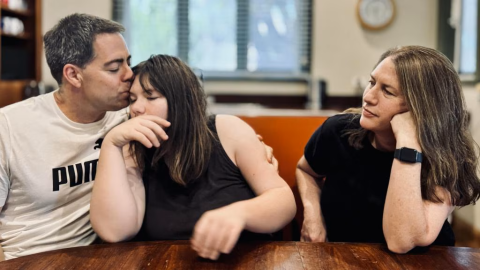
Maddie Lewis (centre) with her dad Simon Lewis and mum Laura Clarke. Picture: Ros Thomas
It’s 7am and Maddie Lewis, 16, is eating cereal in self-absorbed delight. Ignoring my arrival, she doesn’t look up when I sit beside her at the kitchen table. Engrossed in her iPad, she replays over and over a video clip of a bottle careening down garden steps. The sound of glass shattering on concrete elicits a whoop of joy.
Her bowl of milk has run dry but Maddie ploughs on through her bran with a plastic spoon. She will not eat with metal cutlery, has a particular aversion to forks, and registers all fruits and cooked vegetables with disgust. So great is her revulsion for certain foods that she will barricade herself behind cereal boxes to block any view of her family’s dinner. But she’ll eat a hunk of foam from a pool noodle, has chewed through phone cables and swallowed plastic, wiring, and even a foot-long piece of string.
Maddie is considered non-verbal but can say her name, and a jumble of words: “Yes”, “No more”, “Big”, “Five minutes”. “Hot belly” is code for wanting a heat pack for a tummy ache. Left alone with the bag, she’ll tear apart the fabric and eat handfuls of hot wheat.
She is prone to sudden impulses, and when frustrated or frightened is capable of violent rage: gouging, strangling, punching. In full flight, her dad Simon describes her as a “cage fighter”. She has kicked a dentist in the face. Thrown a vaccination nurse against a wall.
But today is a good day. Mum Laura is a study in practised calm. She tops up her daughter’s milk and stands behind her, gently brushing her hair. I hear the glass bottle begin to roll again. By the sink, Simon shoots me a look of weary resignation. Maddie is making soft cooing noises and fumbles for her mother’s hand, pressing it firmly to her cheek.
This is a much-loved child.
Maddie Lewis is profoundly autistic: a Level 3 in a medical system that has no Level 4. She perceives none of the usual rules and codes of social interaction. Instead, she lives in an inner world of unbridled chaos, unable to communicate, struggling to master the simplest of routine tasks.
“This is about as cruel as it gets,” says Simon, 49, a librarian. “She was a beautiful baby, engaged and looking at us and beginning to talk, and all of a sudden she was gone. One day, she just looked straight through me. All her words vanished. It’s the most frightened I’ve ever been.”
![‘The level of hypervigilance required to keep [Maddie] safe is unimaginable.’ Picture: Ros Thomas](https://content.api.news/v3/images/bin/66fa2e6e754754cab24220518d600437)
‘The level of hypervigilance required to keep [Maddie] safe is unimaginable.’ Picture: Ros Thomas

‘She was a beautiful baby.’ Picture: Supplied
Says Laura, 52, a university administrator: “We took her for a hearing test at 18 months, thinking something was definitely wrong. She became so distressed she bit me on the shoulder. I caught the staff looking at each other and overheard one of them say, ‘That’s like my niece who’s autistic.’ The only thing I knew about autism was from watching Rain Man. Our GP said it would take two years for a diagnosis. But we knew no diagnosis meant no services, so we scraped together the money to go private and three months later we were told our daughter had red flags for autism.”
It would be another six months of assessments by a speech therapist, a psychologist and a paediatrician before Maddie’s parents learnt the extent of their daughter’s disability. Hearing the news was “horrific. Just horrific,” says Simon. “They kept telling us how severe she was. I knew then that she’d never leave home, never get married.” His voice catches in his throat and he is so overcome with emotion I have to look away. Through choking sobs he continues: “I was just broken. It felt like we’d been told she was dead. I remember crying like this, pleading for answers: ‘Can we survive this? How will we survive this? What happens to Maddie if something happens to us?’ For a moment there – and I’m ashamed to say this – but part of me wondered, ‘What if we couldn’t manage to look after her? Would they send her away?’”
Simon collects himself as Laura speaks in quiet, measured tones: “I kept telling myself, ‘She’ll be OK. She’ll be OK. But they give you the diagnosis and say, ‘OK. See you later. Go work it out for yourself.’ It was like being dropped off in another country, at night, where you don’t speak the language and being told, ‘You’re on your own.’ Where on earth do you start? And when we did find a great therapist they’d say: ‘Yep, we can book her in, but the waitlist is four years’.”
The parents of profoundly autistic children exist in a no man’s land between coping and not coping. As parents to three girls (Maddie has two older sisters, aged 21 and 19) Simon and Laura know family stability depends on averting the hair triggers that might set off Maddie’s destructive behaviours. And yet, like many severely autistic children, she has developed powers of concentration so intense she can dribble sand through her fingers in raptures for hours. She’ll swim in her bathers in 16C ocean water when all around her are in wetsuits. Her delight in the scariest of spinning rides at carnivals and her exhilaration after a rough ferry passage in huge swells have become family legend.
“She has lots of moments of tenderness,” says Laura. “She’s snuggly and smoochy, her way of showing us love. If you’ve ever seen an autistic child in ecstasy – driving with the wind in her hair, squealing with glee – it’s so gorgeous. Every new skill Maddie masters makes life easier for us and richer for her.”

‘She has lots of moments of tenderness’. Picture: Ros Thomas
And yet a child who is often remote, unreadable and unresponsive tests the limits of parental endurance. Says Simon: “The level of hypervigilance required to keep her safe is unimaginable. Laura has to sleep with her every night. Maddie can attack her out of the blue. And when it happens it’s like watching a street fight, it’s that vicious.
“Two weeks ago, Maddie exploded on me in a carpark. Afterwards, I looked like I’d been clawed by a lion. These are extreme children who become frightened and don’t know what they’re doing. But we need to look after the parents, too. Try to imagine being confined day in, day out with a child who won’t sleep, won’t eat, who screams constantly, your other children are being neglected, and you’re completely and utterly shattered and have nothing left to give. Nothing.”
This couple do not want pity or fearmongering or judgment. They want us to understand how extreme autism inflicts collateral damage on families, how a subset of parents often teeter on the edge. Maddie takes little notice of her parents’ superhuman efforts to reach her. And Laura worries that as Maddie grows older, her world will only grow smaller.
“It’s exceptionally difficult to talk openly about the grim details of your child’s disability. I’d be appalled if anyone reads this and thinks I’m betraying her. We already get pilloried by the other side – those families of neurodivergent children who are ‘high-functioning’, who are quite able to get along in everyday society, who can talk and make themselves understood. Those families want us to say autism is a gift. They have no clue how we live.”
“Let’s be blunt,” says Simon. “Laura and I,” – his voice briefly trails off – “our marriage got very close to breaking. You’re trying to protect your other children. You don’t want their childhoods ruined by this. You’re trying to protect your marriage, trying to protect your sanity. And yet people come at us with all this bullshit, ‘You’ve gotta be positive and affirming with these children.’ Well try being affirming when your 80kg child has got a vice grip on your neck and is shredding your shirt to bits.”
Last month, in Perth’s beachside Mosman Park, a mother and father were induced to carry out an unthinkable crime by the pain of being unable to manage their two severely autistic boys, Leon, 16, and Otis, 14.
Jarrod Clune, 50, and Maiwenna Goasdoue, 49, gassed their boys with carbon monoxide as they slept, before taking their own lives. The family’s pets – two dogs and a cat – were also found dead at the scene. A note on the front door read: “Don’t come in. Send police.“
Call it wilful murder or call it mercy killing, this tragedy has divided public opinion on what constitutes the breaking point for families of impossibly high-needs children.
Texts written in 2012 by Maiwenna (known to her friends as Mai) to a support group shortly after Leon was diagnosed say: “Does it get easier, do you really get used to it? Not feeling that it’s basically killing your entire life? And I’m a positive person normally.”
In another message, she expresses her worry that younger son Otis might also have autism: “I’m a bit scared, seven months ago we were in our paediatrician’s office for the first time with our son, 3 yo, talking about what we thought was just a little speech regression … first time we heard the word autism concerning our son. On Monday we’ll be in the same office with our other little man, 17 months, for what we hope is a bit of speech delay … Scared … In the last month everything has gone out of control, he hardly can say a word anymore, is very violent … can’t have a kid around without [Leon] losing it.” (Texts were not supplied to The Australian Weekend Magazine by the Lewis family.)
In recent years, both Clune boys had been asked to leave their autism-specialist private school due to “challenging behaviours”. Late last year, the NDIS inexplicably cut their support package by 75 per cent.

Otis and Leon, the sons of Maiwenna Goasdowe, 49 and Jarrod Clune, 50. Picture: Facebook
Laura and Simon, who were friends with the Clunes, say a tragedy such as this will happen again if families of Level 3 children aren’t prioritised in a health system that fails to recognise their high support needs. “If you turn up at hospital with your child and say you’re at breaking point, they’ll send you away,” says Laura. “Extreme autism kids get shafted from service to service because they’re so hard to deal with. I know Mai called the police once to manage a situation with Leon being very violent and the police told her they wouldn’t come. If you’re in crisis, you’re on your own. We’ve been there.”
When Maddie was diagnosed aged two, in the pre-NDIS era, she was registered with the state-based Disability Services Commission. Support was “pretty good”, says Laura, and Maddie had a regular caseworker. She moved into the NDIS in 2021, a time of ballooning autums diagnoses. Despite being assessed at Level 3, she hasn’t seen an NDIS worker since.
Laura and Simon’s understanding is that it was no different for Jarrod and Mai.
Says Simon: “I fully understand what would have driven Jarrod and Mai to do what they did. Yes, it’s horrible because it’s murder, but I know where they were at. This will happen again and again because families are gonna blow up. Maddie will not wake up one day as a normal teenager. We have not seen an NDIS case worker in five years, not since the day she entered the system. The NDIS continually tells us, ‘We’re not for parents, we’re for the person with the disability.’ Well, they haven’t come to check on Maddie either. The Clunes had their package slashed with no warning and no reasoning. Mai was a brilliant, wonderful woman with a Masters in Sociology. She would have put her hand up and asked for help if that help had been available.”
For ten years Carrie Clark has been advocatingfor families raising children with disabilities. “The NDIS has a real problem with compassion,” she says. “It’s not unusual for parents of high-needs children to have their support packages cut with no provocation, no in-person case review, no justification. And time and time again, I’ve seen the NDIS decimate the packages of families too worn out to push back. They’re simply looking to cut costs. They’ll do it at random, and they’ll leave it up to the families at breaking point to find the energy to challenge them.’
Clark has helped hundreds of stressed families navigate the health care system. “One of the ways to keep kids with disability safe is to make sure they’re growing up in strong, supported families. The reality, however, is that parents are pushed to the point of burnout because no one is looking out for Mum and Dad, or the wellbeing of siblings. The NDIS treats children with disability as if they exist in isolation, separate from their families.

Disability advocate Carrie Clark. Picture: Ros Thomas
“There is an absolute and urgent need for greater support mechanisms to allow parents to stay in work, stay socially engaged and stay physically and mentally healthy.”
Have successive Australian governments failed to provide adequate services for children with high-support needs? Many would say yes. Sixty years ago, a father’s mercy killing of his four-year-old severely autistic son sent shockwaves through the Menzies Government after a national outcry to have his death sentence commuted. Dr Maurice Benn, head of German Studies at the University of WA, had been told his son Bernard would have to spend his life in an asylum. A physician described the child as a “small wild animal” and “physically normal but mentally backwards”. Benn feared that his wife Irena, who could not manage their son’s ferocity, would break down or take her own life.
On February 8, 1964, while his wife was showering, Benn wrote her a note about their son: “I must save him from such a terrible fate at all costs ... and you from complete collapse.” Signing “With love”, he fetched the .22 rifle he kept in his study, crept into Bernard’s bedroom and shot his son dead.
At his murder trial, Benn testified: “I thought I would save the boy from a terrible kind of life, that I would save my wife. It seemed I just had to do it.” The jury, after just three hours of deliberation, disregarded his plea of insanity and found him guilty. He was sentenced to hang. Newspapers across Australia published letters from parents of other disabled children saying they too had contemplated killing their child because no one understood their isolation and despair. One mother wrote: “Every one of us would have been relieved to see our child die. Perhaps the only reason our husbands have not stood trial for murder is due to one of two things: the good fortune to have a sound spiritual background, or the lack of courage to commit euthanasia for fear of the consequences.”
The late Irena Benn’s best friend was Patsy Millett, 86, who still lives near the University of WA, and whose mother, Mary Durack, was instrumental in leading the 1964 petition demanding that PM Robert Menzies shore up support services for families of disabled children. “This never made it into the court records,” Millett tells me, “but Irena was in crisis. She made constant and frantic calls to her husband while he was lecturing at UWA, telling him he must come home to deal with Bernard. Maurice simply could not take it any longer.
“The one thing Irena and I never discussed was the awful event in her life. She never mentioned Bernard again. A photo of Maurice was in the lounge room, but no pictures of her boy. She needed distraction from thinking about it. Like this recent grim case, much of the public criticism came from those who considered the lack of professional support was to blame.”

Patsy Millett. Picture: Fremantle Press
Three weeks ago the Disability Discrimination Commissioner, Rosemary Kayess, released a strongly-worded statement: “We must reject the idea that disability is a burden – every child has the right to life, safety and support, and families should have access to help well before crisis. There is never a justification for family violence or murder.” Days after the Clune deaths, Kayess called for an urgent coronial inquest into the family tragedy, “to identify the underlying and systemic issues that led to the parents’ actions, and to provide a sense of justice for Otis and Leon”. No inquest had been called at the time of printing.
For Maddie Lewis’s family, the constant anxiety about whether their NDIS funding might be cut without warning means they no longer answer the phone to unidentified callers.
Says Laura: “We know people who’ve answered a random phone call from the NDIS and a month later, a letter shows up saying their support package has been slashed. We live in fear of getting that call. The NDIS seems to have no understanding that we’re a small, extremely vulnerable part of the population.”
Simon is more caustic: “People say to me, ‘How’s your mental health?’ And I say ‘Good.’ Because what else am I going to say? That I’m at rock bottom? I can’t say that because then I’m not fit to look after Maddie. And if I’m carted off, how would Laura cope? A paediatrician once said to us, ‘You know, these kids are like the walking dead.’ Who says things like that? I told him that every night of the year, I take Maddie out for an hour’s drive after dinner to give my girls a breather. He said, ‘You shouldn’t be doing that. You’ll make a rod for your own back.’ Sheesh. I know of a family who drives their boy nine hours a day to keep him calm. We parents will do anything for our children.”
I ask: “What is the future for Maddie?”
“She’ll live with us forever, until we die. And then I don’t know,” Simon says, looking to his wife for encouragement. Laura nods, and adds: “Hopefully her sisters will look after her, but I don’t think our girls properly comprehend what’s in store. As much as we love her, Maddie’s never going to be able to walk the world by herself.”
A big sister emerges from her room in gym gear and heads for the front door. Passing the kitchen table, she pauses at Maddie’s chair, leans over and plants a kiss on her forehead. The sound of a rolling bottle begins again.