
The Labor government announced its Thriving Kids program without saying who it was for. When disability representative organisations (DRO) met officials (4/9/2025 at Parliament House) and asked who it was for, the officials said “work to understand those numbers is yet to be started”.
The announcement refers to “children aged 8 and under with mild to moderate developmental delay and autism” – but it turns out that they really meant “children with developmental delay, or mild to moderate autism and aged under 9 years”. It turns out that the NDIS told a reporter how many kids they thought would be affected in an email on 22/8/2025 (see below).
But the information that the NDIS provided is deeply questionable. And the NDIS is not honest with DROs and the disability community.
The Health Department’s fact sheet on Thriving Kids refers to a review of the NDIS that took little notice of input from the autism sector. Government is scared that the NDIS is being overrun with autistic participants. Originally, the Productivity Commission estimated that 9% of NDIS participants would be autistic … but the NDIS 2025-26 Q1 Quarterly report and the autism snapshot show 41% of NDIS participants have autism as their primary disability type. And a high proportion of the autistic 41% are children and youth.
Autism numbers are increasing everywhere, not just in the NDIS and not just in Australia. Increasing autism diagnoses is a worldwide phenomenon.
The following figure shows how the ABS reports increasing autism diagnoses in Australia.
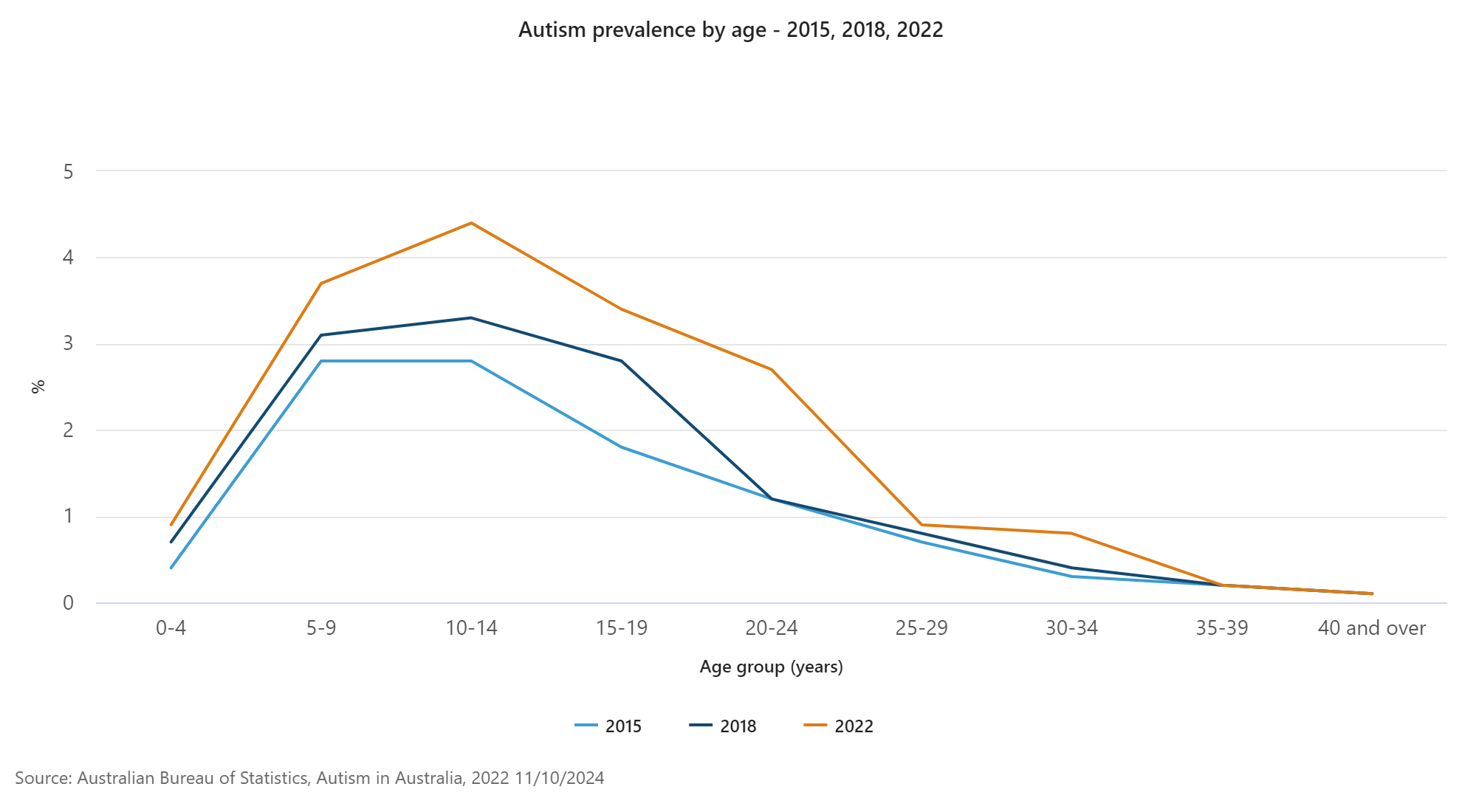
It shows in 2022 a peak of >4% of Australian children are diagnosed autistic, the numbers are increasing, and the children keep their diagnoses as they get older. It does not show spontaneous recovery from autism.
The following figure shows increasing autism diagnosis rates in Australia and in the NDIS.
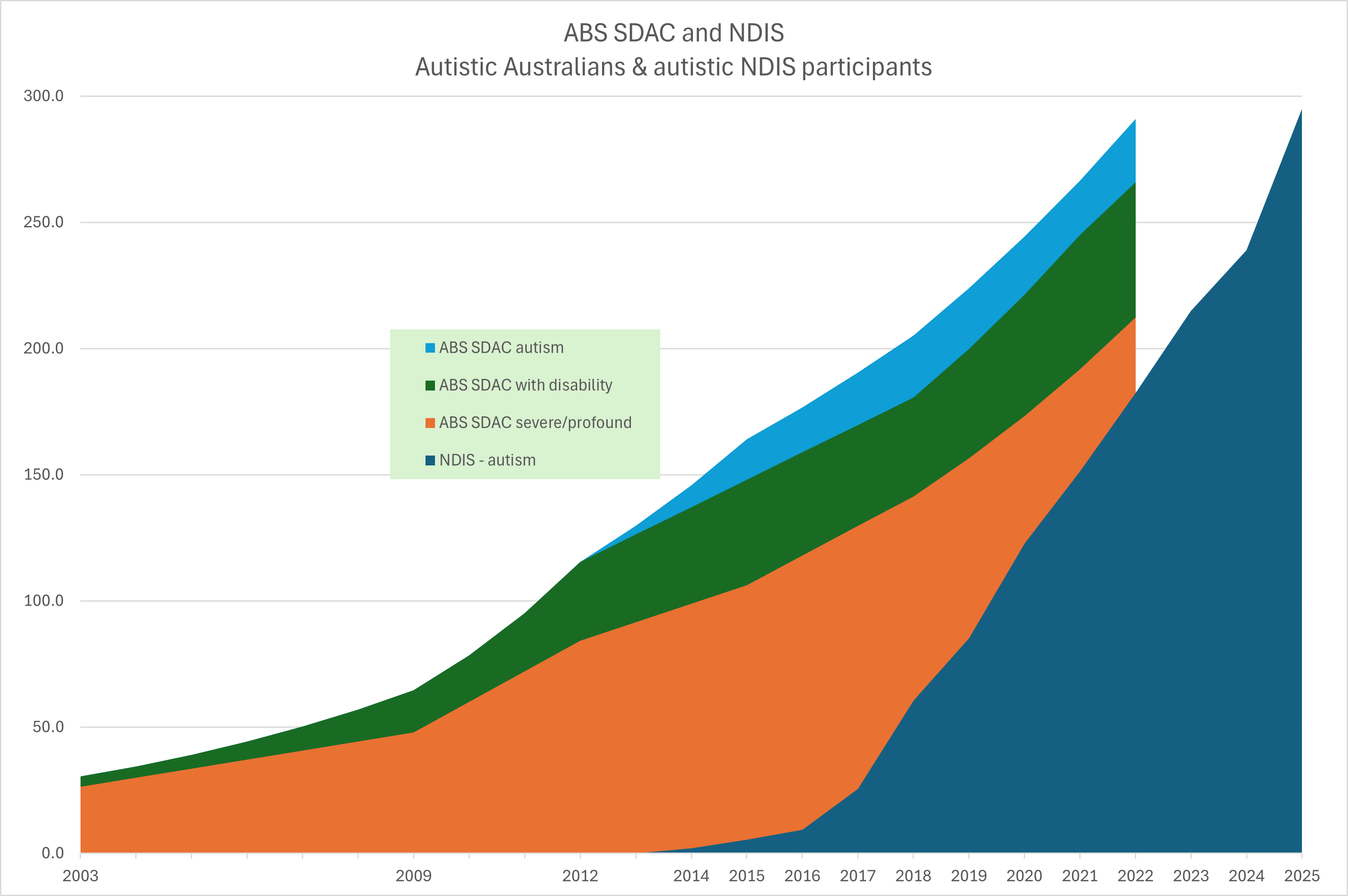
These data show most autistic Australians have severe or profound disability; far fewer than half have mild to moderate disability.
In 2022 at the time of the latest ABS SDAC (and after full NDIS roll-out) there were fewer autistic NDIS participants than the ABS’s estimated number of autistic Australians with severe or profound disability. It is likely there were few if any NDIS participants with what the ABS reported as mild or moderate disability. This contradicts government and NDIS views of autistic NDIS participants.
ABS data from 2022 on autism severity in Australia is in Table 7.1 and 7.3 in their data download.
Note: the government decided recently that it would not repeat the ABS SDAC survey until 2028 … it will not collect data at this time when disability data is needed to inform the Thriving Kids program, Foundational Supports, implementation of the National Autism Strategy, and NDIS reforms.
In relation to children with mild to moderate autism in the NDIS, a recent Freedom of Information (FoI) request response shows that the NDIS wrote an email to a reporter saying:
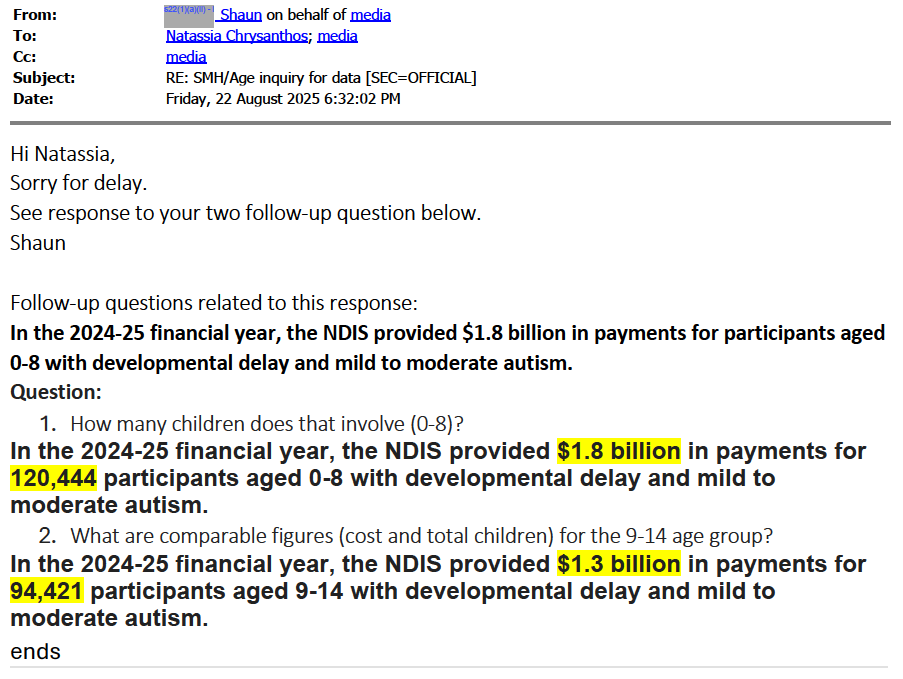
The following table combines data in the email and data from the NDIS website (m-mASD means 'mild to moderate autism') ...
| age range (years) | DD+m-mASD | DD | m-mASD | ASD | %m-mASD |
| 0-8 | 120,444 | 82,680 | 37,764 | 53,042 | 71.2% |
| 9-14 | 94,421 | 753 | 93,668 | 113,701 | 82.4% |
The per cent 'mild or moderate autism' numbers above are calculated from the data sources as follows ...
All ASD aged 0-8 years is 53K (from NDIS data published on their website). All DD is 82.7K (same source). Subtract the DD from the combined 120.4K (in the FoI) to get 37.8K m+mASD in the 0-8 yo age range. 37.8K is 71.2% of 53K (all ASD 0-8yo).
So, Shaun in the NDIS's media section told a journalist that 71.2% of young autistic children in the NDIS have 'mild to moderate' ASD. Presumably this proportion of autistic participants will be ineligible for the NDIS in future; those children, as well as some of the autistic children who are already ineligible for the NDIS, may want to access Thriving Kids or Foundational Supports ... once those programs are underway.
The numbers Shaun reported are similar to those seen in the NDIS’s Table 9 in its autism dashboard for the year to 30 Jun 2025.
It seems that the NDIS sees its internal 1-5 severity rating as 'mild' when applied to autism (this is consistent with FoI response 25/26-0132 that describes "Participants with Autism as primary disability and high level of function (1-5)") and 6-10 severity as 'moderate', while 11-15 severity (ASD is never 15) is 'severe and profound' in the view of the NDIS. It is not clear what severity descriptor they use for autistic kids who they deem ineligible for the NDIS (like they did for HWSN for 6 months before allowing him into the NDIS). A4 doubts HWSN is unique in this regard.
So, the NDIS ignores that autistic kids need to be recognised as severely (or more) impaired to get into the NDIS in the first place ... and comparing NDIS numbers to ABS SDAC data (that is consistent with other sources) suggests that more than 25% of autistic kids do not apply for NDIS supports. This suggests that children with mild to moderate disability due to their autism do not even apply for the NDIS (which is as it should be).
It would be good if the needs of mild to moderately autistic children were met somewhere … such as accommodations in mainstream settings, Foundational Supports, and/or Thriving Kids (more than one option would be good). Meeting their needs is part of the purpose of the UN CRPD. There’s been a lot of talk but no keels have yet been laid for new lifeboats – to revive Bill Shorten’s metaphor.
NDIS severity assessment and reporting for autistic NDIS participants is deeply dodgy. The method the NDIS uses is secret. A4 is not aware that the method’s validity has been tested or reported.
A4 understands that severity ratings for young autistic NDIS participants are often based (at least partially) on PEDI-CAT assessments. PEDI-CAT assessments are known to underestimate autistic impairment. So much so that its authors created a separate assessment specifically for autistic children – that separate assessment is known as the PEDI-CAT (ASD). However, when the NDIS had the Autism CRC review this revised assessment tool, they advised that it still did not adequately assess autistic children – see https://www.autismcrc.com.au/knowledge-centre/publications/reliability-validity-and-acceptability-pedi-cat-asd-scales-australian. The Autism CRC's conclusion says the PEDI-CAT (ASD)
lacks comprehensiveness and relevance when compared to the ICF Core Sets for ASD and has the potential to overestimate functioning.
Using the PEDI-CAT to overestimate functioning of autistic children means underestimating their disability/impairment and support needs.
The PEDI-CAT that the NDIS uses is likely to be even less accurate than the PEDI-CAT (ASD). The NDIS's assessments of autistic children are not accurate and overestimate their functioning or underestimate their impairment/disability. The NDIS and government generally must not use these unreliable assessments as their basis for future exclusion of autistic children from early intervention or for planning disability supports.
The 71.2% of autistic participants that the NDIS described above as “with mild to moderate autism” is a huge proportion of 0-8 yo autistic NDIS participants ... given that most kids with ASD Level 1 do not even apply to the NDIS (unlike kids with DD). We know they do not apply because the NDIS autism dashboard Table 2 shows 96% of NDIS access requests are met (successful).
A4 wrote to the relevant officials on 19/9/2025. The addressee did not even acknowledge the letter … and relevant officials have not responded.
It is unclear why children with global developmental delay (GDD) are not mentioned/considered in all this. NDIS data shows most of these children are also autistic once they get their diagnosis.
Why are these two disability types, DD and ASD, singled out? What about kids with mild or moderate disability (1-5 NDIS severity or more) of another type?
And then there's the NDIS saying only 17.6% (100% minus 82.4%) of 9-14 year-old autistic NDIS participants have severe or profound disability. This level of severe and profound autism is well below other estimates and measures that indicate 25-50% of autistic Australians have profound disability due to autism (e.g. see https://www.abs.gov.au/articles/autism-australia-2022, Tables 7.1 & 7.3 in the associated data download or here).
The NDIS’s view that 82.4% of autistic NDIS participants aged 9-14 years have mild to moderate autism and just 17.6% have severe or profound autism is extremely unlikely. The most likely explanation, given all the above, is that the NDIS’s information about and assessment of autistic participants is seriously wrong. This issue is likely to be a problem for all ages. This also means that it is likely many autistic participants do not get the supports they need.
The number of autism diagnoses are growing substantially all over the world, not just in Australia. Autism is often a severe or profound disability. The Australian government needs to take autism seriously and stop pretending autism is a passing fad. Australia needs real and effective policy and programs for autistic Australians.
6/12/2025
Bob Buckley
A4 Co-convenor