
Media Release
Families of autistic children say they are being left in the dark about how the government will determine which children are classified as having “mild to moderate autism” under the Thriving Kids program.
Recently, government reported on its Thriving Kids program for children with “mild to moderate autism”: it released reports from
Families of autistic children are extremely concerned that governments have not identified which children they regard as “mild to moderately autistic”. The reports fail to provide the number of children involved or how governments will decide which children have “mild to moderate autism”.
Many families agree that existing supports are not working for their autistic children; change is needed. Thriving Kids could work if:
- it properly identifies the cohorts (plural) of children that it will support,
- it uses evidence-based best practices that are specific for all the cohorts of children that it supports, and
- its outcomes are properly and transparently monitored and reported on an ongoing basis.
Thriving Kids cannot be a 5-month quick-and-dirty plug in the NDIS’s ruptured dyke. It cannot be the casting of an already punctured inflatable life raft into the troubled services ocean.
It is too big and too important. It needs to be properly designed and built.
The first challenge is to properly identify who Thriving Kids will support and what supports those people need.
Several Freedom of Information requests reveal how the NDIS assesses “mild to moderate autism”. The NDIS’s response to FOI 25/26-0499 contained the following:
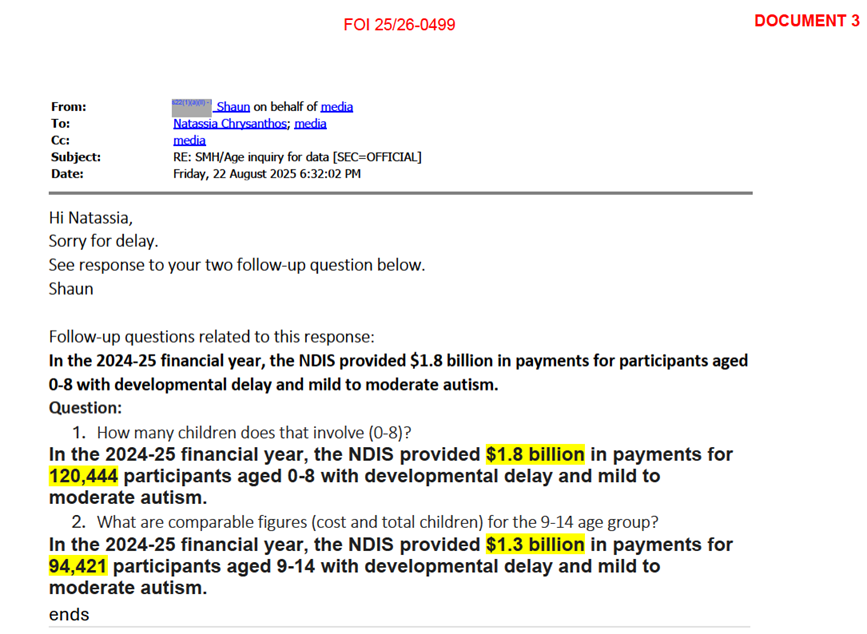
Based on NDIS data for June 2025, the following table shows the proportions of autistic NDIS participants that the NDIS regards as having “mild to moderate” (m2m) autism. The developmental delay and autism columns are from the NDIS quarterly data. The calculation of m2m autism below is based on regarding all of the “developmental delay” cohort as having “mild to moderate” disability – if this is not the case, then the NDIS regards a higher proportion of autistic NDIS participants as having “mild to moderate” disability.
| age range | mild to moderate | developmental delay | autism | m2m autism | m2m autism per cent |
| 0-8 | 120,444 | 82,680 | 53,042 | 37,764 | 71.2% |
| 9-14 | 94,421 | 753 | 113,701 | 93,668 | 82.4% |
FOI 25/26-1009 [LEXD 11072] asked:
“FOI 25.26/0499 includes the statement by your agency to a journalist that "In the 2024-25 financial year, the NDIS provided $1.8 billion for participants aged 0-8 with developmental delay and mild to moderate autism".
Please provide, in accordance with the provisions of the Freedom of Information Act 1982, all information held by your Agency that shows the definition of "mild to moderate autism" that the Agency used in compiling this statistic for the journalist."
and the NDIS responded:
While no document the agency holds describes the definition used in this certain instance, the staff member who provided the information to Media advised us that:
“Our portfolio director confirmed that level of function 1 to 9 was used as an approximation of mild to moderate autism for this media request.
This suggests that the NDIS does not use the severity levels provided as part of a DSM-5 or DSM-5-TR Autism Spectrum Disorder diagnosis report that clinicians provide for every autistic NDIS participant.
Children aged 9-14 years are NDIS participants based on the eligibility due to their disability (Section 24 of the NDIS Act 2013). They are not eligible through the early intervention pathway. This means these autistic children have been assessed as having severe and permanent disability so that they are eligible for NDIS supports.
It is unclear how the NDIS determines its severity (level of function) ratings for autistic NDIS participants. The autism sector has been asking for years but the NDIS declines to say how they do it. The autism sector cannot have confidence in the NDIS’s hidden/secret process.
It is likely that many severity ratings for young autistic NDIS participants are based on PEDI-CAT assessments. This assessment tool notoriously underrates disability in autistic subjects. The authors of the PEDI-CAT assessment created an autism specific PEDI-CAT (ASD) to try to address the issue. But the NDIS did not adopt the PEDI-CAT (ASD) following the Autism CRC’s review – that concluded the PEDI-CAT (ASD), that was better than PEDI-CAT (original) but still, “lacks comprehensiveness and relevance when compared to the ICF Core Sets for ASD and has the potential to overestimate functioning”. So, the NDIS’s severity rating for autistic NDIS participants will “overestimate functioning” and understate autistic participants’ disability.
The NDIS’s assessment of the number of autistic Australians with autism and mild to moderate disability is at substantial variance from reports received from the Australian Bureau of Statistic – see https://a4.org.au/node/2768. The ABS estimates that in 2022, 9.9% of 290,900 autistic Australians (28,799) had mild/moderate disability. This is far fewer than the NDIS’s estimate.
More recently, the Commonwealth Government has shifted its language regarding Thriving Kids to refer to children with autism who have “mild to moderate support needs”:
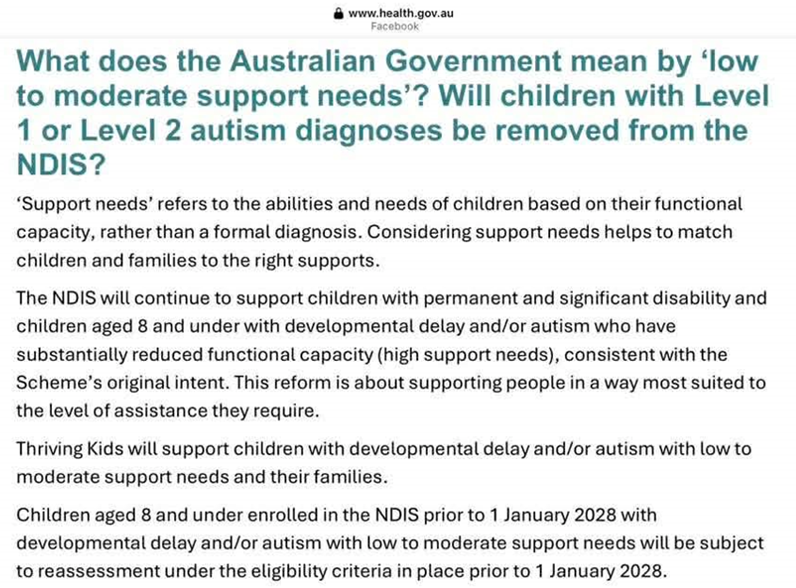
The clinical definition of level 2 and level 3 autism give an assessment of the level of support needs for autistic individuals. These are people who ‘require substantial support’ (level 2) and who require ‘very substantial support’ (level 3). This suggests that it is primarily children who have a lower level of support needs – i.e. those with ‘level 1’ diagnoses - who will be the focus for Thriving Kids.
However, NDIS data reveals that there are proportionately very few children with a ‘level 1’ autism diagnosis on the NDIS:
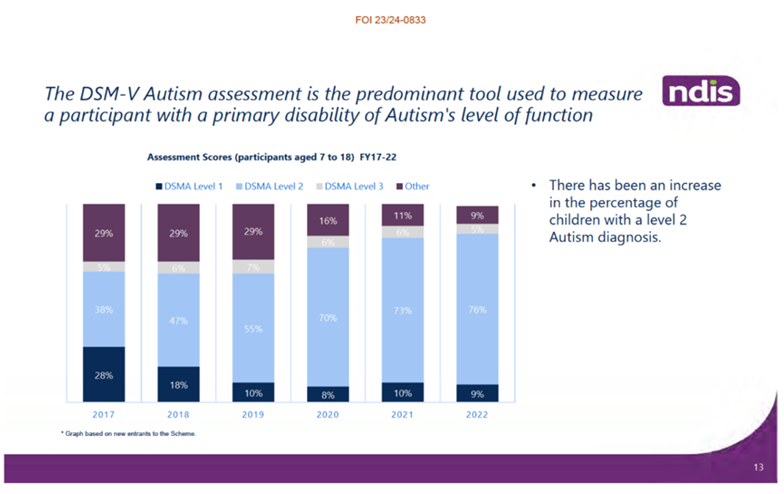
Families are justifiably concerned by the government and NDIS’s expectation that so many children, many of whom have been assessed as with severe impairment, will be transferred to Thriving Kids … especially when there is no information about what supports they will receive for their autism. And why governments think the supports will be “the right supports” for their autistic child. Or even what “the right supports” might mean for their autistic child.
The Government needs to be much clearer about which autistic children it will send to Thriving Kids. Without this transparency, families of autistic children will rightfully fear that the Government’s intent is to arbitrarily redefine children who have substantial or very substantial support needs, as having ‘mild to moderate’ support needs, to reduce the size of the NDIS budget. Which the Government has already said is the primary intent behind the Thriving Kids initiative.
A4 has seen an instance of an autistic child who asked the Administrative Review Tribunal to review their supports, and where the NDIS has not updated the participant’s primary disability type in their NDIS record more than 12 months after receiving the child’s autism diagnosis. NDIS’s participant records are unreliable (at best).
Developmental Delay (DD), defined in the NDIS Act 2013, is the other part of Thriving Kids. The Act describes DD as being limited to children aged up to 6 years.
The autism sector is concerned that changes are more about cost cutting than supporting autistic Australians.
The current cost of “mild to moderate” DD and autism in the NDIS is:
Disability | AgeBnd | Average Budget | m2m DD & autism | cost |
Autism | 0 to 8 | $ 29,000 | 37764 | $1,095,156,000 |
Developmental delay | 0 to 8 | $ 22,000 | 82680 | $1,818,960,000 |
Autism | 9 to 14 | $ 28,000 | 3668 | $102,704,000 |
Developmental delay | 9 to 14 | $ 17,000 | 753 | $12,801,000 |
total | $3,029,621,000 |
The current cost of mild to moderate DD & autism for children with DD and autism in the NDIS is $15 billion over 5 years. The planned $4 billion for Thriving Kids over 5 years[1] is a massive cut in funding. It is reasonable that families are very concerned.
Previously, the NDIS has advised that a high proportion of children with DD remain as NDIS participants after their initial period in the NDIS early intervention pathway, and more of them are subsequently diagnosed with autism than with other disability types.
Data suggests that NDIS eligibility is delaying autism diagnosis and children are diagnosed initially with developmental delay (or global developmental delay - GDD) instead of autism: see https://a4.org.au/node/2587
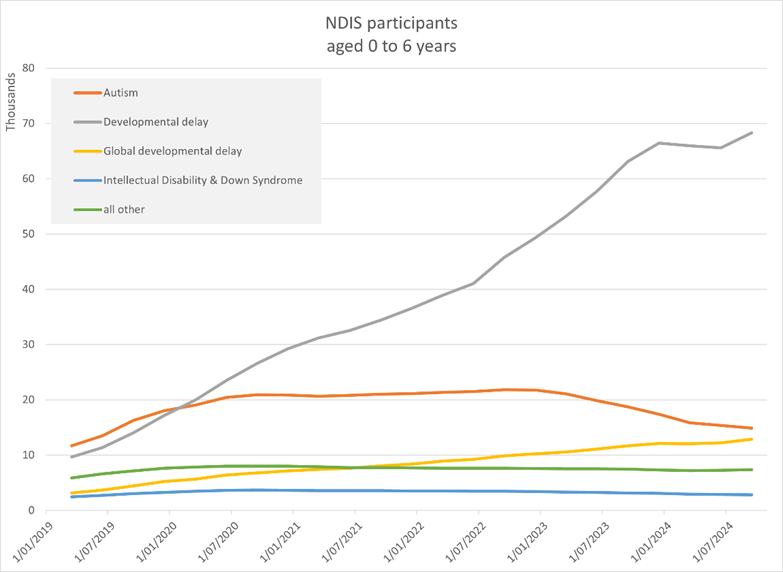
The NDIS has also advised that a high proportion of children with GDD are also subsequently diagnosed to be autistic. GDD is a diagnosis for children up to 5 years of age (or 7 years of age for NDIS participants). It is unclear where GDD fits into Thriving Kids, Foundational Supports, or the NDIS.
It is unclear how the Commonwealth can expect state/territory governments to implement Foundational Supports and Thriving Kids when they cannot know how many children are involved and what their needs are.
Contact: Bob Buckley,
A4 Co-convenor.
25/02/2026